Around 75% of my fishing is spent float fishing, predominantly trotting on rivers, and over the years I reckon I’ve tried just about every line on the market, from 2 lb Bayer Perlon to 8 lb Tournament. I’ve worked my way through most of the major manufacturers and plenty of the lesser-known brands, always looking for that elusive combination of performance and durability.
For me, there are six important characteristics when choosing a decent trotting line: low memory, buoyancy, abrasion resistance, knot strength, stretch and diameter. Getting the balance right is what matters. A line can have an excellent breaking strain for its diameter but be too wiry, or be beautifully supple but sink like a stone. Equally, a line that floats particularly well isn’t much use if it develops coils, twists or a rough surface after a few sessions.
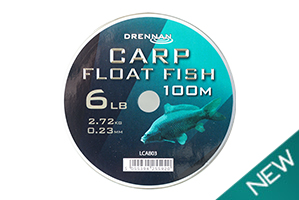
Drennan Float Fish was my go-to line for many years and, at its best, probably came closest to providing the balance I wanted. However, I genuinely believe the quality has deteriorated over the past decade. It also only goes up to 6 lb, which is a limitation when fishing for larger chub or where barbel are a possibility. Nevertheless, I still regard it as something of a benchmark against which I judge other float lines.
Korum Glide was one I really wanted to like, particularly given its claims regarding buoyancy. Unfortunately, I simply couldn’t get along with it. The memory was dreadful, and after only a few casts the line would start singing, vibrating and squeaking through the rings during retrieval. I tried it on several different rods with exactly the same results. Whatever its other merits, I really couldn’t recommend it based on my experience.
Dave Harrell’s float line is another interesting one. Its buoyancy is excellent, and initially it performs very well indeed. Unfortunately, I’ve found that after just a few sessions the surface coating starts to deteriorate and becomes noticeably rough. That rather defeats the object of using a premium float line, especially when you’re trotting regularly and constantly retrieving, mending and controlling line. I find myself replacing it far more frequently than I’d like. A very good line when new, but disappointing in terms of longevity.
Of course, diameter is important, particularly with the lighter breaking strains, but I’m not convinced that chasing the thinnest possible line is necessarily the answer. A little stiffness can actually be beneficial for controlling and lifting line off the water, provided it doesn’t introduce excessive memory. Equally, I want sufficient stretch to provide some cushioning when playing fish, without so much that striking at distance becomes ineffective. Abrasion resistance and reliable knot strength are particularly important when fishing the heavier 6–8 lb lines.
There’s also another characteristic that rarely gets the attention it deserves: how well a line retains its original properties after prolonged use. I’ve used some excellent lines straight off the spool that have become thoroughly unpleasant after only a handful of sessions. For somebody who trots regularly, that’s a significant consideration. I’d much rather have a line that performs consistently over many outings than one that is exceptional for the first couple of days.
At present I’m experimenting with Cadence Edge Mono in several different diameters and breaking strains. It’s far too early to offer a meaningful verdict, and I certainly wouldn’t recommend it purely on initial impressions. The real test will be how it stands up to repeated sessions, particularly its memory, surface finish, buoyancy and general handling.
So, where does that leave my recommendations? Drennan Float Fish remains a line I have considerable respect for, particularly in the lighter breaking strains, although I don’t think it’s as good as it once was. Dave Harrell’s line is excellent for buoyancy but let down by durability, whilst Korum Glide is one I simply cannot recommend following my own experience. Cadence Edge is currently under evaluation and may prove to be a worthwhile alternative.
After decades of trotting, I still haven’t found a line across the 3–8 lb range that delivers everything I’m looking for. Perhaps the perfect trotting line doesn’t exist, but I do think manufacturers could pay rather more attention to long-term performance instead of concentrating on how their products behave when they’re brand new!



 .