• You need to be a registered member of Barbel Fishing World to post on these forums. Some of the forums are hidden from non-members. Please refer to the instructions on the ‘Register’ page for details of how to join the new incarnation of BFW...

Rodbuilding: Harrison Chimera 3

Anthony Block

Senior Member & Supporter
Hello everyone.

First of all, I wish you all a wonderful 2026 year, with plenty of time spent by the water searching for barbel :)
Last year, I discovered feeder fishing for barbel. I started with a Korum Limitless 200 rod.

As a rod builder, and after much research on English forums and Facebook groups, I decided to build a rod based on a Harrison Chimera 3 blank.

In France, Harrison blanks are available on the Rodhouse website. So I placed an order, and six weeks later, I received my package. It was time to start assembling everything :)

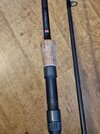
After initially adjusting the cork disks, I began gluing everything together. Once dry, the handle was glued to the blank, along with the reel seat and the finishing rings.

20251225_194009.jpg

20251225_204254.jpg

20251230_211343.jpg

20251230_211406.jpg


And then, my favorite part: sanding the handle. I always really enjoy seeing how the handle transforms after sanding.

20251231_123203.jpg

20251231_133414.jpg

20251231_135534.jpg


We go from the ugly duckling to a nice handle in a good hour of work.

20260102_210056.jpg

20260102_210101.jpg


Now I can go to setting the guides.

I've started with a 25mm guide (a bit big, but I prefer the overall look to a 20mm). I'll go up to 8mm.

I'm not sure yet whether to go with an 8 + top ring or a 9 + top.

By the way, if anyone would be kind enough to share the spacing chart for one of their Chimera 3 blanks, it would give me a starting point for the guide spacing.

To be continued !
 
This rod promises to be magnificent, there's nothing better than a Harrison blank for building a barbel rod. I believe the Chimera is designed to be more progressive and flexible than the Torrix, but I'm not sure?

Can you give us the reference of the guides? I think I can guess it's a set of Sea Guides?

Chimera 3 has 2.25lb TC and may require a 25mm to 30mm starter ring depending on the end use. What weight feeder do you plan to use and what is your target casting distance?

Initially, we weren't supposed to have blanks capable of casting feeders weighing more than 6oz or 7oz. When we mentioned this to carp anglers, they couldn't imagine doing this with their rods, which had their rigs attached, and advised us to use spod rods.

I sincerely believe that a 2.25lb, 2.50lb or 2.75lb blank casting 7oz explosives should use a reel and starter ring suited to this type of use, and in my opinion, the 25mm ring has long since reached its limits for this type of use.
 
Last edited:
This rod promises to be magnificent, there's nothing better than a Harrison blank for building a barbel rod. I believe the Chimera is designed to be more progressive and flexible than the Torrix, but I'm not sure?

Can you give us the reference of the guides? I think I can guess it's a set of Sea Guides?

Chimera 3 has 2.25lb TC and may require a 25mm to 30mm starter ring depending on the end use. What weight feeder do you plan to use and what is your target casting distance?

Initially, we weren't supposed to have blanks capable of casting feeders weighing more than 6oz or 7oz. When we mentioned this to carp anglers, they couldn't imagine doing this with their rods, which had their rigs attached, and advised us to use spod rods.

I sincerely believe that a 2.25lb, 2.50lb or 2.75lb blank casting 7oz explosives should use a reel and starter ring suited to this type of use, and in my opinion, the 25mm ring has long since reached its limits for this type of use.
Im also a advocate for 30 mm up to 10mm anti frap on any barbel rod of 2.25 and up to 2.75. .
Not only for casting performances but weed clearance on the tip also.
Also a big fan of the alps cwg ai on all my rods including float rods the rubber insert is so comfortable....
 
Im also a advocate for 30 mm up to 10mm anti frap on any barbel rod of 2.25 and up to 2.75. .
Not only for casting performances but weed clearance on the tip also.
Also a big fan of the alps cwg ai on all my rods including float rods the rubber insert is so comfortable....
This rod promises to be magnificent, there's nothing better than a Harrison blank for building a barbel rod. I believe the Chimera is designed to be more progressive and flexible than the Torrix, but I'm not sure?

Can you give us the reference of the guides? I think I can guess it's a set of Sea Guides?

Chimera 3 has 2.25lb TC and may require a 25mm to 30mm starter ring depending on the end use. What weight feeder do you plan to use and what is your target casting distance?

Initially, we weren't supposed to have blanks capable of casting feeders weighing more than 6oz or 7oz. When we mentioned this to carp anglers, they couldn't imagine doing this with their rods, which had their rigs attached, and advised us to use spod rods.

I sincerely believe that a 2.25lb, 2.50lb or 2.75lb blank casting 7oz explosives should use a reel and starter ring suited to this type of use, and in my opinion, the 25mm ring has long since reached its limits for this type of use.
Looks like he's already got lined rings rather than Vortex Air / Sea-guides? As for ring sizing (especially butt rings) there is a load of BS in carp circles about this; especially the use of 50mm butts rings over 40mm on 12' rods to create a minimal if any casting advantage.
 
Hi,
the rings are American Tackle pentalite.
My actual choice is 25-16-12-10-8-8-8-8-8 + top, with two rings on the but section.
I fish a lot on the Sauer River in Luxemburg (small/medium river) but sometimes on the Mosel River too, who is much bigger, a little bit like the Meuse River in France.
 
Hello everyone.

First of all, I wish you all a wonderful 2026 year, with plenty of time spent by the water searching for barbel :)
Last year, I discovered feeder fishing for barbel. I started with a Korum Limitless 200 rod.

As a rod builder, and after much research on English forums and Facebook groups, I decided to build a rod based on a Harrison Chimera 3 blank.

In France, Harrison blanks are available on the Rodhouse website. So I placed an order, and six weeks later, I received my package. It was time to start assembling everything :)

After initially adjusting the cork disks, I began gluing everything together. Once dry, the handle was glued to the blank, along with the reel seat and the finishing rings.

View attachment 37367
View attachment 37368
View attachment 37369
View attachment 37370

And then, my favorite part: sanding the handle. I always really enjoy seeing how the handle transforms after sanding.

View attachment 37371
View attachment 37372
View attachment 37373

We go from the ugly duckling to a nice handle in a good hour of work.

View attachment 37374
View attachment 37375

Now I can go to setting the guides.

I've started with a 25mm guide (a bit big, but I prefer the overall look to a 20mm). I'll go up to 8mm.

I'm not sure yet whether to go with an 8 + top ring or a 9 + top.

By the way, if anyone would be kind enough to share the spacing chart for one of their Chimera 3 blanks, it would give me a starting point for the guide spacing.

To be continued !
Here’s some measurements from my C3,s But ring 25-20-16-14-14-12-12-10-10 Kigan guides measured from outside to outside. 2 on bottom section 25-20 then the other 7 on the top section. Photos show measured from inside edge of top reel Seat band upwards and then bottom of top section upwards. Tip not shown as can only post ten photos.
A089C458-204A-4CC1-BCD0-BAF575D332D7.jpeg
F1BD2836-49FB-433B-926C-DCD26B47C48F.jpeg
0A03BC80-41BF-4853-B557-9D66DB808D86.jpeg
E79BAA7D-28DC-4323-8B14-D5F293937C03.jpeg
7F380BE6-9062-4E03-B788-05DF6362565E.jpeg
915FD427-5561-4F14-8DA5-13C9641DC193.jpeg
BDB14446-C925-45FC-92F7-1078B15887C6.jpeg
99580F18-B48D-4D7E-BEA2-9287BF7E5CBB.jpeg
8B113B56-ED0C-4783-8997-0D925BAAD345.jpeg
F2DBA59B-635A-436F-83B4-A0B099A3DCB2.jpeg
 
I use mine on the middle river Trent which is a large river and can cast a loaded large open ended 4oz feeder across to the far side in most places maybe 70 yards when needed I’ve even managed to get hung up in trees on the opposite bank! 🤭 and I’m not a big cast’er by any means 😉
 
Here’s some measurements from my C3,s But ring 25-20-16-14-14-12-12-10-10 Kigan guides measured from outside to outside. 2 on bottom section 25-20 then the other 7 on the top section. Photos show measured from inside edge of top reel Seat band upwards and then bottom of top section upwards. Tip not shown as can only post ten photos.View attachment 37379View attachment 37380View attachment 37381View attachment 37382View attachment 37383View attachment 37384View attachment 37385View attachment 37386View attachment 37387View attachment 37388
Thank you Jim, I will try it tomorrow !
Didn't find any good option tonight :-/
 
Never built a rod myself but in terms of ring location isn't 'finding the spine' (and marking rings on the correct side of the blank) key prior to spacing them? Apols Anthony if you know this already!
 
The problem with the alps reel seats is they don’t flex and on a rod that is designed to bend through is an accident waiting to happen
I just recently got of the phone with Terry Edmonds and the conversation got around to alps seats and he said in his time he has blown 7 butt sections and everyone had an alps reel seat fitted
Most rod builders won’t gaurentee rods built with alps reel seats fitted
 
Hi Anthony. Looking very nice.
I've built/ altered a few Harrisons lately.
I have built two Chimera 2's and altered a Chimera 1 which I bought cheap with a long handle and too many rings for my liking.
I have gone for the traditional look favouring plain cork, Fuji dark grey reel seats and Kigan 3 leg rings. All components were bought from Guides and Blanks. Got knows where I will get what I want in future!
Anyway, I know you specifically asked for ring spacings for a Chimera 3 but in case you want to try the spacings I used for the Chimera 2's they are, from 8mm tip: 51/2, 51/2, 6, 9, 101/2, 13, 15, 16 and 19. 10 rings including anti frap tip ring.
I dont like long handles and have gone for 21 1/2". Obviously if you are casting any distance you will prefer a longer handle.
Rods are a very personal thing.
Have fun!
 

Attachments

  • 20260106_101614.jpg
    20260106_101614.jpg
    145.9 KB · Views: 23
I don’t fully understand the choices of ring sizes. Looking at the theory behind Fuji K type rings the position and size of the first ring should be related to the reel in use. I think the K type rings were developed for shorter spinning rods. I’m not aware of guidance from Fuji for carp and barbel rods. But I feel the theory can apply.
I assume the carp guys want the large rings to reduce line friction on the rings hence their fascination with large and few rings. I just feel they are loading their rods with extra weight.
Lots of guide manufacturers seem to copy Fuji k type rings and I think @Anthony Block is using a K type copy.
I never need to cast far so although I researched rings for my own builds I don’t need to fully follow either Fuji theory or the carp guys large ring technique.
If you are using ‘k’ type rings and need to cast distance, it may be worthwhile looking at the k type theory.
 
I don’t fully understand the choices of ring sizes. Looking at the theory behind Fuji K type rings the position and size of the first ring should be related to the reel in use. I think the K type rings were developed for shorter spinning rods. I’m not aware of guidance from Fuji for carp and barbel rods. But I feel the theory can apply.
I assume the carp guys want the large rings to reduce line friction on the rings hence their fascination with large and few rings. I just feel they are loading their rods with extra weight.
Lots of guide manufacturers seem to copy Fuji k type rings and I think @Anthony Block is using a K type copy.
I never need to cast far so although I researched rings for my own builds I don’t need to fully follow either Fuji theory or the carp guys large ring technique.
If you are using ‘k’ type rings and need to cast distance, it may be worthwhile looking at the k type theory.
I think, also being a Carp and all round angler, that the use of large rings on Carp rods is, to a certain extent, overplayed and is often merely fashion lead. In the early days of Carp fishing rods had standard sized rings and 8 -:10 rings. All this changed towards the end of the 80s with people like Jim Gibbinson leading the way. This was due to fishing at range on big waters where longer casting became more popular. The position of the rings, particularly the butt, is more important than the size. Once you get towards 100 yards then the 50mm butt rings become more effective. Combined with a big pit type reel smaller rings will lead to 'frapping' where the line catches around the rings ( mainly the butt) so on a distance rod it is worth having them. For distances of up to 80 or 90 yards they aren't necessary in my view. On that basis, I can't see the point of putting them on a Barbel rod though if you also intend to use the rod for gravel pit Tench there may be some merit.
I just use standard Kigan rings and they are all you need as far as I have experienced.
These are just my personal views over many years of Carp, Barbel and specialist fishing though. 🙂
 
@Lee - have also heard this with regards ALPS metal seats creating issues / cracking blanks - only ever had a set on my 12' Aviator Plus and hated the blank anyway - the 'cold' and heavy reel seats made them even worse IMO (although they did look super sexy!)

@Andrew J - totally agree; large butt rings (50mm+) are fashion led and make little if any difference to mortal / non comp conditions casts. I will say however as a primarily fluro / heavy mono mainline user (and not braid) for carping specifically I do like the unlined 'air' type guides in 5x plus tip set up as they make a massive difference in overall rod weight etc . . .
 
Now I can go to setting the guides.

I've started with a 25mm guide (a bit big, but I prefer the overall look to a 20mm). I'll go up to 8mm.

I'm not sure yet whether to go with an 8 + top ring or a 9 + top.

By the way, if anyone would be kind enough to share the spacing chart for one of their Chimera 3 blanks, it would give me a starting point for the guide spacing.

To be continued !
looks good, looking forward to seeing it as the build progresses.
 
Hello everyone,

lots of interesting ideas and discussions on this topic :)

I've never heard of a rod breaking due to a particular type of reel seat. I'm not sure if a more flexible reel seat would really stay that way after epoxy bonding and would truly minimize the risk. But why not? I don't yet have much experience or perspective on building rods specifically designed for carp or barbel fishing.

I rarely need to cast very far; distances are often less than 20 or 25 meters. The only constraint is that the Sauer River is a small/medium-sized river, but the current is "strong". I most often use feeders between 90 and 150 grams to ensure a good working position. That's why I went with a Chimera 3, and not a lighter model.

For fishing in the Moselle river, I will see in practice what the casting limits of the Chimera are, and if necessary, I will still use my Korum rod for distance.

A French YouTuber who has a rod-building channel said something I really like: in rod building, just do what you want!

I think that's true (while of course respecting certain constraints); the advantage of rod building is being able to do what you love. Building a rod is a very personal thing.

The AT Pentilite guides are quite similar to Fuji's KW guides, but are a bit taller, hence my choice.

The KR "strict" concept is indeed based on building a rod specifically for the reel you intend to use. However, reel choices can change over time, and sometimes it's necessary to find a compromise and find something more versatile.

In my case, it will be a Shimano X Aero 6000 RA. It's big, it's heavy, perhaps not the most suitable, but it's a reel I really like!
This choice may evolve towards something lighter and smaller over time.

Let's get back to the rod build.

I had some difficulty with the placement of the guides on the tip section to find something suitable.

I tried the configuration suggested by Jim, but I wasn't convinced by the placement of the stripper and the reducing guides. However, for the tip guides, I found it to be a good starting point, so I adjusted the distances of the stripper and the reducing guides to find something that worked well while maintaining the correct spacing for proper reduction before the tunnel.

I'll put everything under tension tonight to see how it performs, but I think I've found the final layout.

Thanks again for your feedback, ideas, and advice.
 
Never built a rod myself but in terms of ring location isn't 'finding the spine' (and marking rings on the correct side of the blank) key prior to spacing them? Apols Anthony if you know this already!

Finding the spine is indeed an important step in rod building; in fact, it's one of the first steps. But the placement of the guides is also crucial. One doesn't work without the other.
 
I only build rods for myself, so not many, so I’m interested to see how you get on. If you can get a picture of the rod under tension I would be interested to see it.
Be careful that you don’t apply a point load to the blank when you apply loads to the rod, you don’t want to break it during testing.
If there is any chance of damaging the rod just to get a photo .. please don’t do it!
Remember to limit the loading to the force you are likely to apply. This will probably be a lot less than the breaking strain of line you will use. Try lifting loads with other rods to get a feeling of the maximum load you are likely to apply.
 
Back
Top